Table of Contents
Summary
Strong evidence for a pedestrian accident claim can help establish fault, document injuries, and support financial losses after a California pedestrian crash. Photos, medical records, witness accounts, police documentation, and video footage may all play important roles. Learn what Fil-Am families should collect and preserve.
A pedestrian crash can disrupt a family’s life in seconds, creating immediate questions about fault, injuries, and what should be saved. For Fil-Am families in California, strong evidence for a pedestrian accident claim can connect a driver’s conduct to the harm that followed.
Los Angeles pedestrian accidents may involve busy intersections, turning vehicles, distracted driving, or conflicting stories at the scene. Early documentation can also reduce disputes when memories fade, physical conditions change, or digital records are erased.
Below, we’ll explain what evidence to collect, ano ang dapat i-preserve, at paano ito makakatulong sa isang California injury case.
Why Evidence Matters in a California Pedestrian Accident Claim

Pedestrian accidents are generally evaluated under negligence rules. California Civil Code § 1714 ties liability to injuries caused by a lack of ordinary care while also considering the injured person’s conduct.
California Vehicle Code Section 21950 requires drivers to yield in marked and unmarked crosswalks at intersections and to exercise due care. Pedestrians must also use reasonable care.
Proof becomes especially important when California’s fault-sharing laws are disputed. It can clarify crosswalk violations, impact points, speed, visibility, and right-of-way.
What Photos and Videos Should You Collect After the Accident?
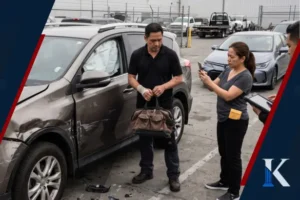
On Wilshire Boulevard, Sunset Boulevard, or near Beverly Hills, traffic can change quickly. If it is safe, photograph signals, lane markings, debris, lighting, property damage, vehicle position, and visible injuries before conditions change.
Useful digital proof may include:
- Dashcam footage from involved or nearby vehicles
- Vehicle data showing speed or braking
- Wide photos of the intersection and sight lines
- Close images of roadway marks and vehicle contact areas
Itago ang mga original na file at siguraduhing may backup ang mga ito.
How Police Reports and Witness Statements Support Your Case
Obtain police reports when available. They may contain accident descriptions, diagrams, party details, cited violations, and names of people who saw the collision.
Witness statements can help when accounts conflict. A witness may describe speed, signals, phone use, or where the pedestrian was before impact.
Save contact information promptly. A pedestrian accident attorney in Los Angeles can compare these accounts with physical and digital evidence.
Why Medical Records Are Essential to Proving Your Injuries
Medical records can connect the collision to symptoms, diagnoses, and medical treatment. Keep medical bills, medical expenses, prescriptions, referrals, and injury documentation. If symptoms continue, schedule your doctor’s appointments.
Records may be important for head injuries, traumatic brain injuries, spinal cord injuries, facial fractures, nerve damage, organ damage, vision problems, and other catastrophic injuries. Psychiatric evaluations may document significant emotional or cognitive effects.
This evidence can support future medical care costs, lost wages, pain and suffering, and other damage calculations.
Can Traffic Camera and Surveillance Footage Strengthen Your Claim?
Yes. Surveillance footage from nearby businesses, homes, parking areas, or transit property may show signal timing, travel direction, visibility, or driver behavior.
Act quickly because recordings may be overwritten. In hit-and-run accidents, video may help identify a plate, vehicle, or direction of travel.
For complex cases, video can be compared with phone records, physical evidence, and expert analysis to build a clearer timeline.
How Filipino Families Can Help Preserve Important Evidence
Family members can divide evidence tasks while an injured relative recovers. Keep one folder for photographs, receipts, treatment records, correspondence, policy documentation, and employment records. A dated journal can record mobility limits, missed work, sleep problems, and daily changes.
Save communications from insurance companies, but be cautious with broad recorded statements. Insurance adjusters may request more information than necessary.
A pedestrian accident attorney in Los Angeles may coordinate settlement calculations, settlement proposals, and settlement negotiations while addressing claim denial issues or possible bad faith practices.
Evidence Checklist for a California Pedestrian Claim
Evidence | What It Can Help Show |
Scene photos and video | Signals, visibility, road conditions, and contact location |
Medical and work records | Injury severity, treatment, income loss, and financial compensation |
Official and witness records | Independent accounts and possible traffic violations |
Insurance and vehicle records | Coverage, ownership, conduct, and policy limits |
Family records | Daily-life effects and possible Loss of Consortium |
Together, these materials can strengthen evidence for a pedestrian accident claim. Pedestrian laws depend on the facts, and California pedestrian laws also interact with personal injury law principles. A personal injury lawyer can assess the complete record.
If a dangerous public roadway condition contributed, government liability rules may apply. A public-entity injury or death claim generally must be presented within six months under Government Code § 911.2.
Frequently Asked Questions
What is good evidence for a claim?
Good proof is timely, reliable, and tied to a disputed issue. Photos, video, medical records, eyewitness accounts, repair documents, and electronic records may all help. Strong evidence for a pedestrian accident claim should show both how the collision happened and how the resulting injuries affected the victim.
How much is typically awarded in a pedestrian injury lawsuit?
There is no standard value. The amount depends on the severity of the injury, available coverage, fault, treatment costs, income loss, future care needs, and long-term effects. Wrongful death cases may involve various types of damages. A case review can help families assess potential value without relying on generic settlement averages.
What are the five elements that must be proven to prove negligence?
Negligence is commonly described in terms of duty, breach, causation, and damages. Some explanations divide causation into actual and proximate causes, thereby creating five elements. In personal injury law, the evidence must connect the defendant’s conduct to the injury and the specific losses being claimed.
What injuries are hard to prove?
Injuries without obvious external signs can require stronger documentation. Persistent headaches, nerve symptoms, cognitive changes, vision complaints, chronic pain, or psychological effects may depend heavily on clinical findings and consistent records. Gaps in care can give insurers more room to dispute whether symptoms came from the collision.
What is the deadline to file a pedestrian accident claim in California?
California’s general statute of limitations for injury or death caused by another person’s wrongful act or neglect is two years. Public-entity matters can require much earlier notice. Wrongful death claims and cases involving minors or other exceptions may require separate timing analysis with legal counsel.
Your Evidence Can Shape What Happens Next
After a pedestrian crash, preserving records early can make a difference in a future legal battle. Keep photographs, treatment records, employment documents, correspondence, and any item that shows how the collision changed daily life.
Kapwa Justice provides legal advocacy for Filipino families throughout Los Angeles County and California. Contact us today for a free consultation. Our team can review your situation, explain next steps, and help you decide whether pursuing a claim is right for your family.