Table of Contents
Summary
When a trucking company denies fault after a crash, families may face delays, claim denial, and pressure from insurance companies. This guide explains liability denial tactics, key evidence, and legal options in California. Learn practical steps to protect your injury claim and secure fair compensation.
A serious crash involving large commercial trucks can turn a normal drive down I-5 near Elk Grove or the 405 by Carson into a life-changing event. But the stress often intensifies when a trucking company denies fault after a crash.
Families may suddenly face mounting medical bills, lost income, and confusing calls from insurance adjusters. For many Filipino-American families in California, this creates not only financial strain but emotional pressure to settle quickly.
Knowing what comes next and how to respond wisely can protect your rights and future. Here’s what you should be aware of.
Why Would a Trucking Company Deny Fault After a Crash?
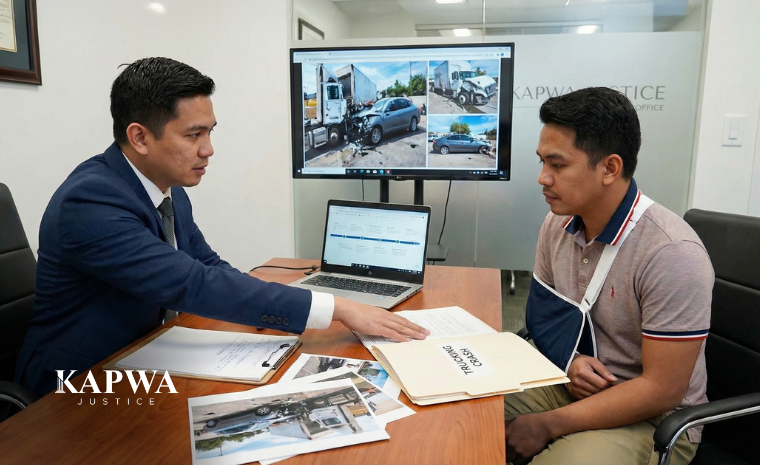
When a trucking company denies fault after a crash, it is often a calculated legal strategy.
Truck accidents frequently result in severe injuries because commercial trucks weigh tens of thousands of pounds more than passenger vehicles. According to federal transportation data, more than 40,000 people lost their lives on U.S. highways in 2023. Collisions involving large trucks make up a significant share of fatal roadway incidents.
A denial may be based on:
- Allegations that the truck driver was not negligent
- Claims that another vehicle caused the crash
- Arguments that weather or road conditions were to blame
- Disputes over injury severity
- Delays intended to pressure victims into low settlements
A liability denial does not mean the case lacks merit. It means the dispute has entered a more complex legal phase.
What Laws Apply to Truck Accidents in California?
California follows a fault-based system. This means the party responsible for the crash is financially liable for damages.
Truck accident cases are also governed by strict federal regulations and federal and state regulations enforced by agencies such as the Federal Motor Carrier Safety Administration (FMCSA). These rules address:
- Hours-of-service rules (to prevent driver fatigue)
- Vehicle inspections
- Driver qualification standards
- Cargo securement by cargo loaders
- Maintenance requirements
Violations of these safety rules may indicate negligence on the part of the trucking company. Crash data consistently show that driver fatigue, mechanical failures, and improper maintenance are recurring factors in serious large-truck collisions.
When a trucking company denies fault after a crash, your legal team must examine whether regulatory violations occurred.
What Evidence Can Prove Liability?
Strong evidence often determines whether an injury claim succeeds after claim denial.
Critical Evidence in Truck Accident Cases
Type of Evidence | Why It Matters |
Police report | Documents initial findings and witness details |
Dashcam footage | May capture the moment of impact |
Black box data | Records speed, braking, and driver inputs |
Maintenance records | Shows whether required servicing occurred |
Medical records | Links injuries directly to the collision |
Accident reconstruction reports | Scientifically analyzes crash mechanics |
Accident reconstruction experts can review accident reconstruction reports to determine speed, braking distance, and impact angles.
Other documents may include:
- Driver logs (to evaluate driver fatigue)
- Evidence of mechanical failures
- Documentation of driver qualification compliance
- Photographs of property damage
- Medical reports confirming injury severity
When a trucking company denies fault after a crash, securing this evidence early is essential. Some data, such as black box data, can be overwritten if not preserved quickly.
What Should You Do If Fault Is Denied?
Sa ganitong sitwasyon, huwag agad panghinaan ng loob. If you receive notice that the trucking company denies fault after a crash, take the following steps:
1. Do Not Argue with Insurance Adjusters
Insurance adjusters represent insurance providers, not you. Avoid recorded statements without legal representation.
2. Preserve All Documentation
Keep copies of:
- Medical records
- Medical reports
- Repair estimates
- Insurance claim correspondence
3. Seek Legal Guidance Immediately
An experienced truck accident lawyer can evaluate your injury claim and identify weaknesses in the denial.
4. Avoid Quick Settlements
Some insurance companies issue low offers, hoping families will accept them before understanding the long-term damage.
5. Request a Full Investigation
This may include subpoenaing maintenance records and driver logs.
For families searching for the best truck accident lawyer in California, experience with commercial trucks and federal regulations is critical. Complex cases demand a specialized strategy.
How Does This Affect Filipino-American Families?
Many Fil-Am families prioritize unity, hard work, and financial stability. A serious crash disrupts all three.
In communities from Daly City to Historic Filipinotown in Los Angeles near Temple Street, extended families often share financial responsibilities. When a parent is unable to work due to injuries, the entire household feels the impact.
In cases involving wrongful death, the emotional toll is profound. California law allows surviving family members to pursue compensation for financial support losses and other damages.
Unfortunately, some families hesitate to challenge large corporations due to fear, language barriers, or unfamiliarity with legal systems. This is where culturally sensitive legal representation matters.
A knowledgeable truck accident lawyer understands how trucking company strategies work and can push back effectively.
Why Are Truck Cases More Complex Than Regular Car Accidents?
Truck accidents differ from ordinary collisions because:
- Multiple parties may share liability (driver, trucking company, cargo loaders)
- Large commercial trucks are subject to additional oversight
- Corporate defense teams act quickly
- Evidence disappears faster
In some truck accident cases, insurers attempt to deny claims by arguing comparative fault. California’s comparative negligence rule allows recovery even if you share some responsibility—but compensation may be reduced.
Understanding this nuance can prevent premature settlement decisions. Again, if a trucking company denies fault after a crash, complexity increases—but so does the importance of a strong investigation.
Families seeking the best truck accident lawyer in California should prioritize firms experienced in accident reconstruction and regulatory compliance.
FAQs
Does a denial mean I won’t recover compensation?
No. A liability denial simply signals a dispute. With proper evidence and legal representation, many denied claims are successfully resolved.
What if the truck driver says I caused the accident?
Statements alone are not decisive. Evidence such as dashcam footage, black box data, expert witness testimony, and police report findings carries more weight.
Can the trucking company be liable even if the driver made the mistake?
Yes. Employers are often responsible for employee actions within the scope of their job duties.
Should I speak directly to insurance companies?
It is usually best to consult a truck accident lawyer first, especially after a claim denial.
Denial Is a Delay—Not the End of the Road
When a trucking company denies fault after a crash, the situation can feel overwhelming. But denial is not the final word. With careful documentation, professional investigation, and strong advocacy, families can challenge unfair insurance claim decisions.
Truck accidents often involve significant damage—physical, emotional, and financial. You deserve clarity, accountability, and fair treatment under the law.
If your family is facing a liability denial, contact us today for a free consultation to review your case and pursue the compensation you may be legally entitled to.